
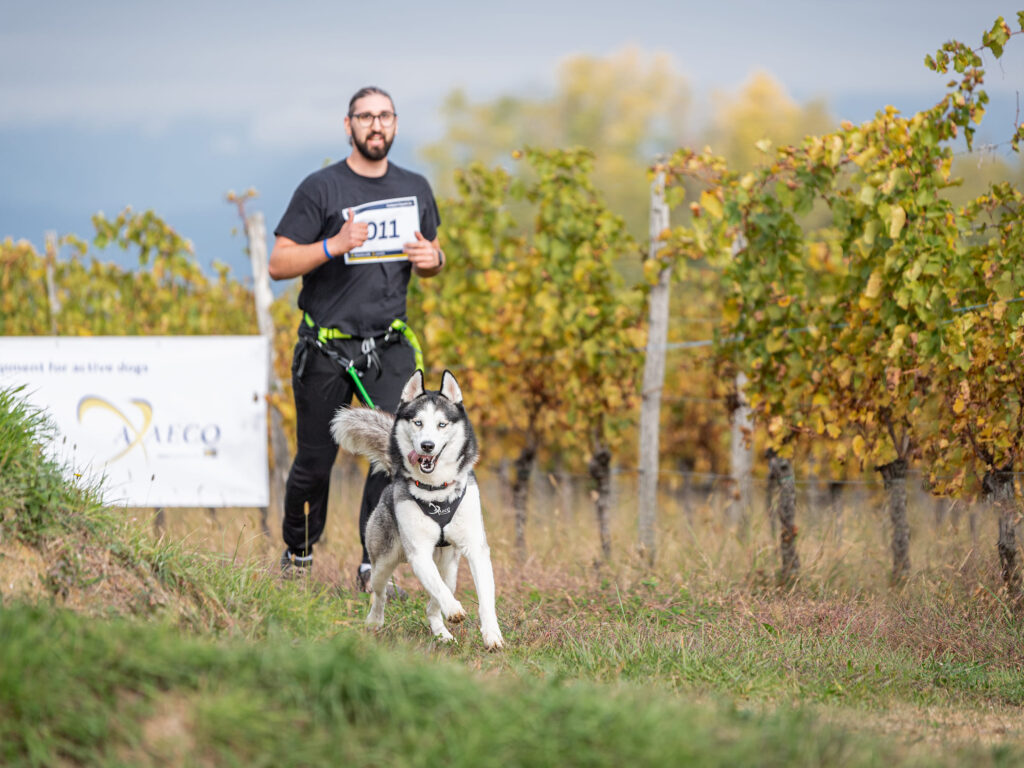
What is Canicross?
Canicross is a sport in which you and your dog run together, connected by an elastic line which attaches to your dog’s special pulling harness, and to a belt for you which is designed to distribute your dog’s pulling force evenly across your body. The idea is that you use your dog’s momentum to help you run faster.
Canicross began as a way of training sled dogs during the off season, when there’s no snow, before becoming a sport in its own right.
Canicross is accessible to everyone and suitable for all dog breeds, though especially suited to sporty dogs; it combines the pleasure of exercise with the fun of getting outdoors with your dog.
As with all sports, training for both you and your dog obviously needs to be tailored to gradually work towards your own, individual, sporting goals. It is essential to create close synergy between runner and dog so that you are, eventually, able to run at the same pace and have fun together.
The best time of year for Canicross is from autumn to spring, avoiding the hot summer months.
During these cooler months, many Canicross competitions are organized by numerous federations and dog clubs around the world, in accordance with international regulations, and always ensuring maximum respect for animal welfare.
Competitive Canicross races are run over Sprint distances (maximum of 7 km and minimum of 2 km, for adults and children). These distances are increased for Dog Trail races, where the length of the course, never under 10 km, must not exceed 25 km. These long distance races should only be attempted with a lot of training and a perfectly healthy dog!
If you and your dog are beginners, no worries, here is everything you need to know!
Is Canicross suitable for your dog?
Canicross is an activity that can be practised at many different levels, from jogging a couple of kilometres to sprinting up to 7 kilometres with your dog. This makes it accessible to most types of dogs.
Health
First of all, it is important to assess your dog’s health and consult a veterinarian to determine whether the sport is suitable for them. If there is even a small chance of them being affected by dysplasia or other joint issues, then they may need x-rays to be cleared for canicross. While these conditions don’t necessarily prevent a dog from participating, they will require adjustments to your training plan.
Keeping dogs with joint issues in good shape is important, as strong muscles can help reduce strain on the joints. However, high-impact activities can also worsen existing problems.
Motivation
You should also consider your dog’s willingness to run and pull. While most dogs can learn to enjoy the activity over time, it’s important not to force them, as this can create a negative association to the sport.
In canicross competitions, most dogs are northern or pointing breeds. However, many herding breeds, retrievers, and various shepherd breeds can also perform very well in canicross with the right motivation. While any dog can participate, it is generally easier to achieve higher speeds with larger dogs (over 15 kg).
Some breeds, such as small companion dogs or molossoid types, are less likely to perform at a high level, but individual dogs can still enjoy running with you. Special care should be taken with brachycephalic dogs, as they may struggle with breathing and are more prone to overheating during physical activity.
What equipment do I need?
In Canicross your dog is on a lead and runs in front of you.
Runners wear a specific type of belt (lightweight and comfortable) to which you attach the lead. Canicross leads are elastic and shock-absorbing. Leads with an additional safety handle near the carabiner clip are highly recommended.
Wearing a belt means that you always have your hands free while you run but can still keep your dog under control.
The shock-absorbing lead attaches to the dog’s harness (never to their collar) with a carabiner.
When you train with your dog, choose your equipment carefully to ensure maximum comfort and safety for you both.
Here is a list of the essentials you need for running with your dog.
Runner
→ Sportswear
which is suitable for the weather conditions you plan to run in.
→ Shoes
Given that Canicross involves running off-road, you should use trail running shoes, preferably with grippy soles to give you more traction on slippery or muddy ground.
→ Canicross belt
Canicross belts let you attach your dog’s lead to your waist so you can run with your hands completely free. The belt distributes the dog’s pulling power onto the runner and allows greater freedom of movement.
Dog
→ Pulling Harness
A Canicross harness should be specifically designed for sport (padded, ergonomic, comfortable, made of hypoallergenic and breathable materials, in the correct size), suitable for dogs to run in, and different from harnesses for walking. Your dog’s shoulders must be completely free so that they can move with a full, natural stride and their harness should not press on their neck, as this could affect your dog’s breathing.
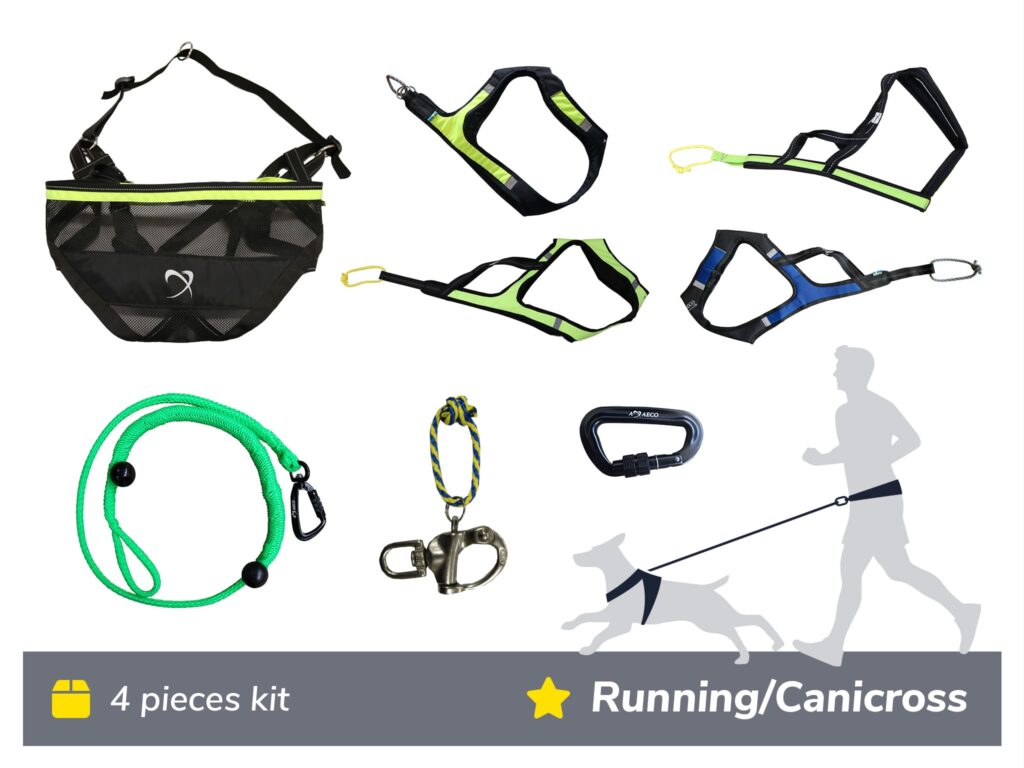
At Axaeco we offer 4 different pulling harnesses:
Harness X-Run
Harness X-Shirt
Harness X-Shirt 2.0
Harness Scandinavia
Learn about their different features and find the best fit for your dog in our article “Pulling harness – Guide”.
→ Elastic Line
In Canicross, a line that stretches from 1m 50 to 2m when fully extended is recommended: this elasticity protects both yours and your dog’s back from sudden jerks.
At Axaeco we offer three different elastic lines suitable for canicross:
As well as 2 bungee connectors:
→ Carabiner Canix Belt
While it is possible to attach some lines directly to your belt with a knot, a simple carabiner can make your life easier.
→ Booties
If the terrain is extremely treacherous and/or your dog has very sensitive paws and pads, sleddog booties are recommended. As with other equipment, your dog needs to be gradually introduced to wearing them.
Kipmik Booties Duragrip for soft and/or snowy ground.
Kipmik Booties Cordura 500D, a light bootie for hard, rough terrain.
Tibesti Booties, a very resistant bootie for hard, rough terrain.
Discover the full guide here “Booties – Guide”.
What are the ideal conditions for Canicross?
Terrain
Canicross should be practised on natural trails. It is important to choose softer ground as running on hard surfaces like asphalt can place significant strain on your dog’s joints.
Temperature
Canicross is a demanding sport and can quickly raise your dog’s body temperature to dangerous levels. It is best practised in cool weather as it can become unsafe above 15°C.
Of course, the exact threshold for heatstroke varies from one dog to another, but it’s always better to be safe and follow this general guideline. If you’d like to learn more about training in warmer conditions, check out our article “Hot-Weather Pulling Sports with Your Dog: Safety, Limits and Useful Strategies”.
How to start Canicross?
Once you’ve found the right place to start and acquired the proper equipment for both you and your dog, you’re ready to start running!
Before any training session, remember that you both need to warm up properly. Start with a short walk, this will also give your dog the opportunity to relieve themselves so they won’t need to stop during the run. Before you begin running, do some simple exercises, such as asking your dog to give their paws at head height or having them turn in both directions.
An important element of canicross training is keeping your dog motivated, right from your very first run, to ensure that this great activity stays enjoyable for you both.
It is worth noting that the principle of pulling and running while on the leash doesn’t come instinctively to all dogs. Therefore we recommend starting with short, regular sessions of brisk walking before you gradually increase the pace and distance of your outings.
Praise your dog often, and you can use other forms of positive reinforcement too, such as rewarding them with food or play after a good run with consistent pulling.
Try to run on trails where there are few distractions to help your dog stay focused.
Don’t forget to give your dog rest days during the week, and continue doing other activities such as sniff walks.
It may take some time to properly run in sync and find the right pace for your duo. You can also train on your own to better match your dog’s rhythm if needed.
If you’d like advice or support while learning pulling sports, don’t hesitate to reach out to local canicross clubs. They offer a great opportunity to learn from others and can also boost your dog’s motivation by running alongside or behind other dogs.
Teaching your dog commands can make your runs smoother: go, stop, right, left, in front, slow down, in line… Since your dog runs ahead in canicross, it can be difficult for them to understand the direction you want them to take without verbal cues, whereas in other activities body language is often enough. Repeat the commands consistently so your dog learns their meaning. You can also practice them during dog trekking to remove the pressure created by speed in canicross. Commands can also be taught during regular walks or through dedicated training sessions using positive reinforcement.
How to improve in canicross?
You can work on different aspects of your dog’s fitness:
- Speed: Practicing bikejoring can help increase your dog’s top speed.
- Endurance: Activities like dog trail running or hiking are great for building stamina.
- Strength: Training on hilly routes helps develop muscle and power.
- Cardio: Interval training is highly effective for improving overall cardiovascular fitness (we cover this in our article “Boosting for CaniX!: Interval Training”).
Hydration and Nutrition
If you practice canicross at a high level and regularly, your dog should be fed accordingly. You can find food designed for active or sporting dogs, typically with higher levels of fat and protein. You can also include supplements in their diet to support joint health.
Hydration should be carefully monitored during training. Read our article “Hydration of canine athletes” to learn more about this essential topic.
Competitions
Competitions can be a great opportunity to meet like-minded people and assess your team’s progress. Of course, dogs don’t care about results, so your priority should be keeping the experience enjoyable and positive for them as well.
Before races you are usually allowed, and encouraged, to walk the course with your dog. This helps both of you identify potential challenges and better understand the route. Familiarising yourself with the course can reduce the risk of accidents and even save valuable time during the race.
Race distances are typically around 5 km, but may vary between 3 and 7 km depending on the category and the season.
It is common practice to feed your dog well in advance of the race (at least 4 hours before) and to limit their water intake about 2 hours beforehand to reduce the risk of bloating.
As the start time approaches, remember to warm up both yourself and your dog with a walk and some targeted exercises.
After the race, regardless of the result, you can be proud of your team. Allow time for a proper cool-down with a walk, let your dog rehydrate, and consider giving recovery supplements if needed.
Conclusion
Canicross is a great sport that is accessible to many dog owners! Whether you’re aiming to start competing or just looking for a fun way to stay active together, the key is to progress gradually, respect your dog’s needs, and prioritize their well-being at every stage. With the right equipment, suitable conditions, and a positive approach to training, canicross becomes an incredibly rewarding activity that strengthens both your physical fitness and the unique bond you share with your dog.
If you are looking for a quick way to start with Canicross, have a look at our Canicross Starter Kit!
FAQ
– Asking too much, too soon from your dog
– Skipping the warm up!
– Training in unsafe conditions (hot weather, asphalt trails)
– Running with a growing puppy, an out-of-shape dog or a dog with health issues
– Feeding or giving water just before or after strenuous physical activity which can cause bloating
– Using the wrong equipment
As a high-impact sport, canicross is not suitable for puppies. From a young age, you can let your puppy run freely to help build muscle and develop good habits, but a pulling harness should not be used until your dog has fully finished growing.
If you adopt an adult dog, take the time to first build a relationship and ensure they feel comfortable and confident with you. It’s also important to gradually improve their physical condition so they can handle canicross without risking mental or physical stress.
Canicross is not suitable for overweight dogs, as the impact of running while carrying excess weight can be harmful to their joints. Instead, focus first on helping your dog reach a healthy weight through a balanced diet, regular walks, swimming, and low-impact fitness activities. Once your dog is physically fit, you can gradually introduce pulling sports.
Your dog should be excited to put on their harness, eager to pull, and generally in good spirits when engaging in the activity.
First, try to identify the reasons behind your dog’s reluctance to participate in the activity.
Start by checking their health with a veterinarian to rule out any underlying issues that could cause discomfort or pain.
It’s also possible that your pace is not suitable for your dog, either too slow or too fast. If your dog needs a higher pace to stay engaged and enjoy the activity, you might want to consider alternatives such as bikejoring or dog scooter.
If your dog seems unsure or uncomfortable with the harness, make sure it fits properly and has been checked by a professional before giving up on pulling sports.
If it turns out your dog simply doesn’t enjoy pulling sports, that’s perfectly okay. There are many other activities you can enjoy together that help strengthen your bond, such as obedience, mantrailing, dog dancing, agility, hoopers, disc dog, herding, swimming-based sports, SUP, hiking and more.