
This article is not meant to encourage running in hot weather. Just the opposite! We want to explain why training in the heat can be unsafe for dogs. That said, we also know that some people will choose to do it anyway, so our goal is to help reduce the risks and help you avoid serious issues such as heat stroke.
It’s essential to remember that dogs and humans regulate heat very differently. We humans cool ourselves by sweating thanks to sweat pores, which are located all over our body, while dogs are only able to dissipate heat through their paw pads and via their tongue by panting. This means that dogs are far more prone to overheating during physical activity, especially when the weather is warm.
You also need to remember that some dogs are so eager to work and make their human happy that they ignore their own warning signs. These dogs rely on us, their handlers, to recognize when it’s time to stop, and that is often before the dog would choose to stop of its own accord.
Pulling sports are undeniably safer and far more enjoyable for dogs at temperatures below 18°C. Research has shown that the ideal temperature for a sled dog to take part in pulling sports is actually around just 10°C. Of course every dog copes with heat differently. Breed, coat type, age, and physical condition can all influence their heat tolerance. Nordic and thick-coated breeds may struggle more in warm conditions, and overweight or poorly conditioned dogs are also at greater risk of heat stress.
With that in mind, we hope that this article can offer a practical perspective on training at higher temperatures and how to approach it as safely as possible.
Our most important recommendation is to start with short training sessions in moderately warm conditions and increase exposure as gradually as possible. This serves two key purposes:
- It allows your dog to acclimate to higher temperatures through controlled, progressive exposure
- It helps you better understand your dog’s individual abilities and recognize their limits
Be warned, acclimatization also has its limits. Some people argue that dogs living in hot countries don’t suffer from heat stroke so that must mean that their organism is able to adapt. However, studies show that in regions where dogs are regularly exposed to very high temperatures, they naturally adopt a much slower walking pace and reduce their activity levels as a protective mechanism.
Another often-overlooked factor is temperature shock. Avoid extreme contrasts such as blasting air conditioning indoors and then heading straight outside into 35°C heat. A temperature difference of more than 5-10 °C between indoors and outdoors can make it much harder for dogs to cope with warm conditions.
A dog going directly from a heavily air-conditioned environment into physical activity is far more likely to suffer from heat stress or heat stroke than a dog who has been resting and warming up calmly in the shade outdoors before training.
Finally, don’t forget to take humidity into account. High humidity significantly reduces a dog’s ability to cool down through panting. Even moderate temperatures can become dangerous when humidity is high, because evaporative cooling is much less effective.
Some basic advice for your canicross training sessions in hot weather:
Hydration
Offer water frequently, including water mixed with electrolytes, to help replace what your dog loses through activity and heat.
Body cooling
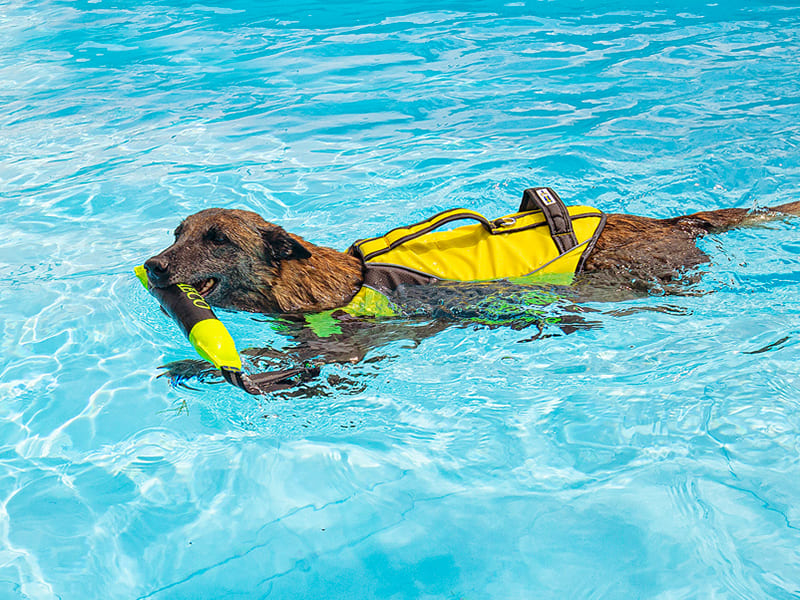
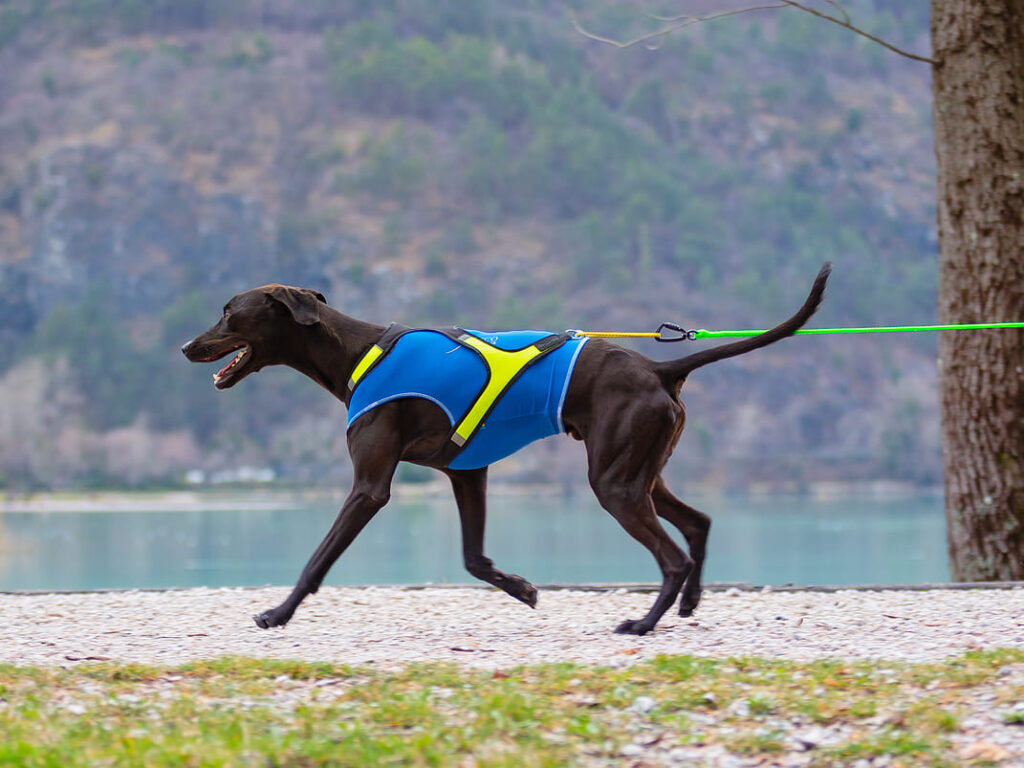
Refresh your dog regularly by soaking them with water. Running near a lake, river, or the sea and allowing them breaks to cool off in the water can significantly reduce their risk of overheating. Alternatively, you can use cooling equipment such as cooling harnesses, vests, or products like our All Rounder (soaked in fresh water) to help regulate body temperature during training.
Training schedule
Run early in the morning or later in the evening, never during peak midday heat.
Paw protection (booties)
Test the ground with the back of your hand for a few seconds. If it’s too hot for you to keep your hand there comfortably, it’s too hot for your dog’s paws and it means protective booties are necessary.
Know the warning signs
Learn to recognize the signs of heat stress and heat stroke and what action to take if necessary. If your dog begins to pant excessively, drool heavily, vomit, suffer from diarrhoea, develop a rapid heartbeat, or collapse, you must act immediately. Move them to a cooler, shaded area, offer small amounts of water gradually, and wet their body with room-temperature water, never ice-cold water. After any suspected heat stroke, you should always have your dog checked over by a veterinarian, even if they seem to have made a quick recovery.
Conclusion
Ultimately, the responsibility always lies with the handler. A motivated, eager-to-please dog may keep running despite early signs of fatigue or overheating, which makes it essential for their human to make conservative decisions and stop before the dog reaches its limits.
We hope this information encourages you to think twice before running in summer conditions, and helps you better assess your dog’s individual abilities while keeping their safety a priority.
Remember you can also reduce risk by adapting your training style! Consider running with your dog off leash or trotting on a long line rather than in a pulling setup. This still provides exercise and mental stimulation while significantly lowering the physical effort and effects of heat on your dog. You can also replace running entirely with swimming, the safest full-body workout in summer heat.