
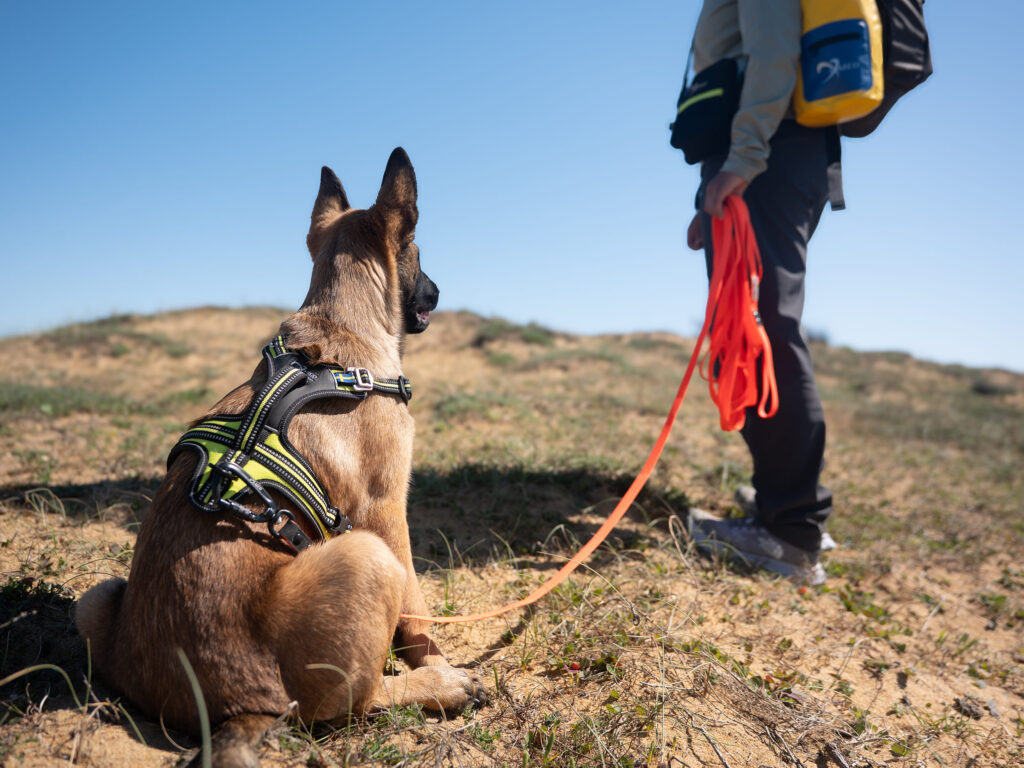
A long line, also called a tracking lead, is an essential tool for many activities with your dog: such as training, behavioral rehabilitation or specialized work such as mantrailing. Used properly, long lines combine safety, relative freedom and controlled learning. This guide explains when to use a long line, what length to choose and how to use one effectively.
Why Use a Long Line?
A long line allows your dog to move freely over a much greater distance than a standard leash, while still being under your control. It is particularly useful in 4 situations:
- Safety and supervised freedom: your dog can explore and move around without the risk of them escaping or having an accident.
- Recall training: a long line helps you safely work on recall even in open spaces because you always have a way of retrieving your dog.
- Behavioral rehabilitation: fearful or reactive dogs can work at a distance from their triggers without putting themselves or others in danger.
- Specialized work: in activities such as mantrailing, a long line is essential as it allows the dog to concentrate and move freely, in complete safety as they follow the trail.
What Length Should You Choose: 5 or 10 metres?
The length of the long line depends on the type of activity you are going to do and the space available. The most common lengths are 5 meters and 10 meters.
The 5-metre long line
-
Why use it?
The 5-metre long line is ideal for beginners or in more enclosed spaces, such as a garden or a park. It allows your dog to move freely while remaining under control, without the line becoming taut. -
Advantages:
- Enhanced safety in areas where other people or dogs are present.
- Ease of managing the dog’s movements.
- Ideal for gradual behavioral rehabilitation exercises.
The 10-metre long line
-
Why use it?
A 10-metre long line is suited to open or larger spaces and to people who already have an intermediate to advanced level in using a long line. It offers greater freedom while remaining safe. -
Advantages:
- Lets you work on recall from a greater distance.
- Ability to combine free exploration with directed exercises.
- Ideal for dogs that need more physical space or mental stimulation.
Important note: A long line should never be taut, and shouldn’t be used to pull or correct your dog. It serves only as a safety net. It follows the dog’s pace and, ideally, should not touch the ground.
How to Use a Long Line Correctly?
Proper use of the long line is essential to ensure your dog’s safety and the effectiveness of the exercises. These are the main recommendations:
Safety first: always on a harness, never on a collar
Long lines must always be attached to a suitable harness such as our 4 Season Fit, never to a collar or any other improvised equipment for safety reasons: a dog running at speed when the line becomes fully extended is going to experience a strong jolt: on a harness the force is spread across the chest while on a collar it would impact the neck and trachea.
Position of the line
Ideally the line should stay slack without touching the ground: it is there to control distance and ensure safety, not to steer your dog. In some cases it can be used as an intermediate step between on- and off-leash work, by letting it drag on the ground behind the dog.
How to hold and handle a long line
Using a long line properly is a learning process. Your hands need to learn to control several metres of line, while your reflexes need time to develop so you can catch and release the line smoothly. One hand should hold the loops you create to prevent the long line from dragging on the ground, while the other hand allows the line to slip between two fingers as your dog moves forward. If your dog slows down, the second hand can quickly create new loops and pass them to the first hand.
By keeping the long line from becoming slack, you can avoid common problems such as the line getting caught around trees, people or other dogs.
For your safety, avoid wrapping the long line around your fingers, wrists or ankles. If your dog is likely to pull hard, consider wearing gloves to protect the skin on your hands.
Simple Recall work
Call your dog and reward them generously to reinforce the desired behaviour. Let your dog move around freely without pulling on the line: the line is only there to prevent mistakes, giving rewards builds recall.
Storage and maintenance
Coil the line carefully after each use to avoid knots, and check its condition regularly for any damage to ensure your dog’s safety: go over the carabiner, rivets, stitching and surface. PVC long lines are the easiest to maintain, as they can be cleaned very easily, don’t absorb water and therefore won’t go mouldy.
Shock absorbance
Even if you are an experienced user of long lines, mistakes can happen, and your dog may be able to build up momentum before you have time to get a proper hold of the line. To protect your dog’s back from sudden jerks, you can add an elastic connector between the harness and the long line.
Our Bungee Cord is designed to absorb potential shocks at the end of a leash or tracking lead. It’s only 30cm long which prevents it from dragging on the ground.
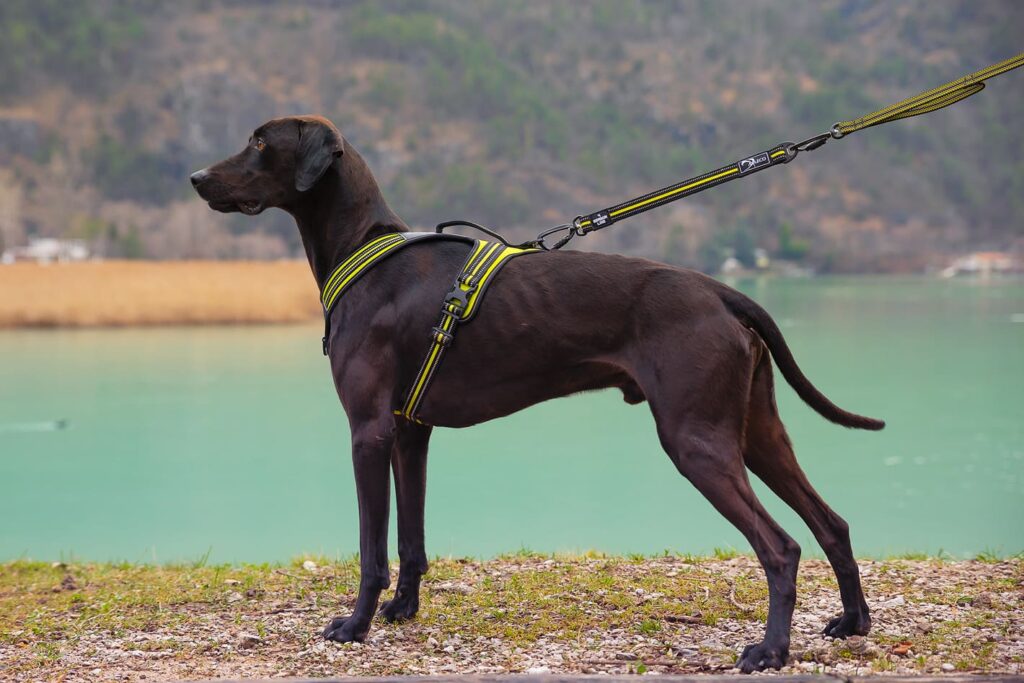
Any other elastic leash, line or connector can be used to absorb shocks and thus increase your dog’s safety on a long line.
Browse Axaeco Elastic Leashes, Lines and Connectors ›
Which Axaeco Tracking Lead should you choose?
Once you know the length you need and how you’ll use the line, the choice comes down to your preference for grip, visibility and material. Axaeco’s two tracking leads cover everything you might need!
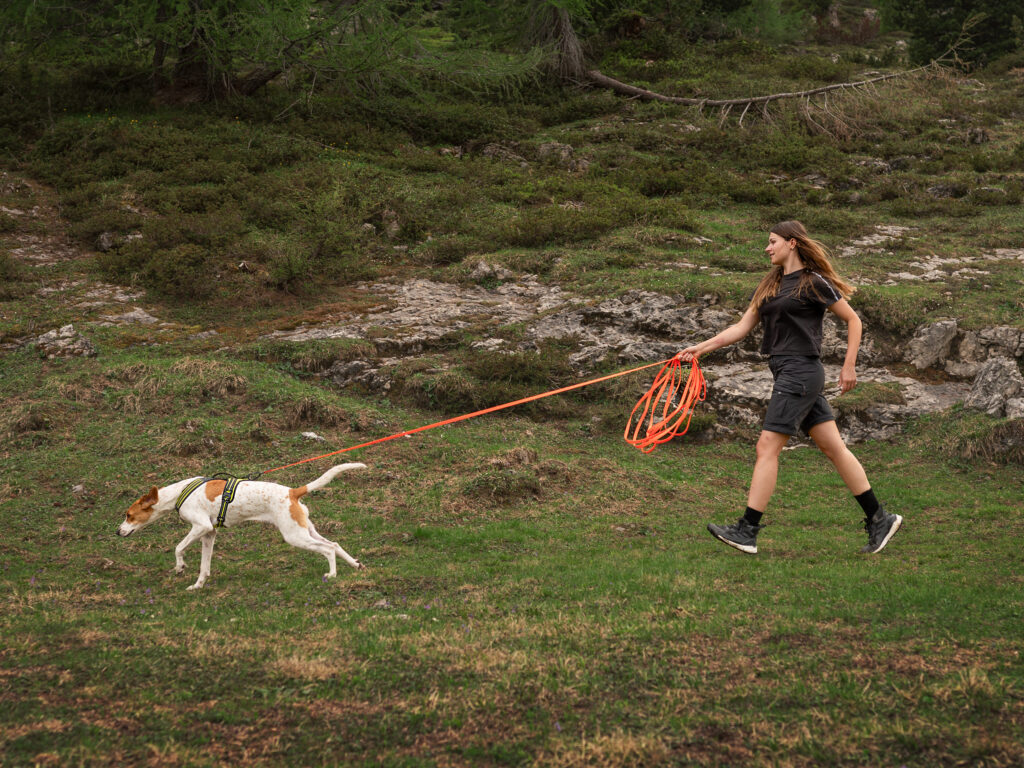
Action Tracking Lead: for visibility and all-weather walks
- Made from durable PVC, it’s easy to clean and doesn’t absorb water. This is very useful in muddy or wet conditions.
- Bright orange colour for maximum visibility of the line on the ground and in vegetation.
- Available in 5m and 10m lengths, with two carabiner options to suit dogs of different sizes.
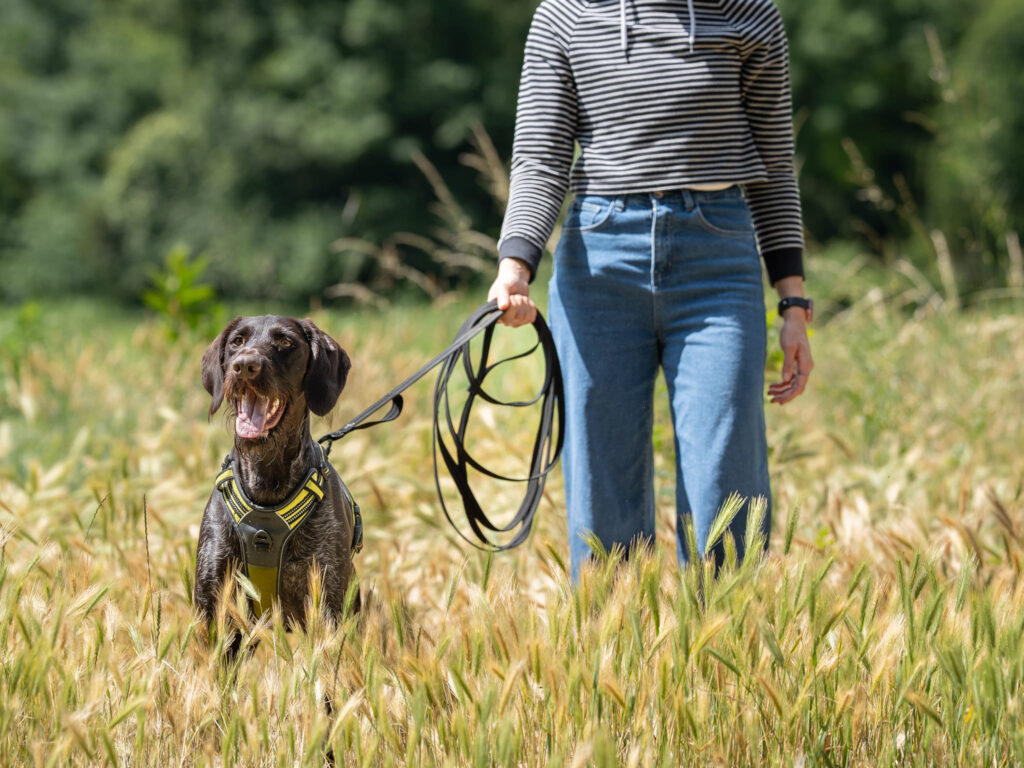
Grip Tracking Lead: for strong and reactive dogs
- Its integrated rubber provides a secure, comfortable hold, making it ideal for strong and/or reactive dogs.
- An additional handle close to the harness gives you greater control when needed.
- Available in 5m and 10m lengths, with a twist-lock carabiner for added security.
BONUS: The Elastic Tracking Lead
If your dog is a strong puller and you wish to use a fully shock-absorbent long line, here is our tip: create an elastic long line by using our Extra Long Line coupled to the Grip Handle (or any other leash!). It has the same advantages as the Action Tracking Lead: highly visible and doesn’t absorb water.
In Conclusion
A long line is a safe and versatile tool for recall work, behavioral rehabilitation and activities such as mantrailing. The right length depends on where you plan to use it and your experience level: 5 metres for beginners and restricted spaces, 10 metres for more experienced handlers and larger areas. Used correctly, attached to a harness, without tension, it lets the dog move freely and safely while supporting progressive, structured learning.
FAQ
No. Always attach a long line to a suitable harness. Your dog can reach real speed even when running over a relatively short distance, and if they run out of line the sudden stop on a collar would put the full force on their neck and trachea which could be painful or capable of causing serious injury.
Start with 5 metres if you are new to long lines. Move to 10 metres once you can handle the line comfortably and have access to larger, quieter spaces.
Ideally no, it should stay slack and off the ground. However, letting it drag can be a deliberate intermediate step between on- and off-leash work, in safe environments where it cannot get caught on bushes or other objects.
Yes, it is one of the most useful tools for training reactive or anxious dogs, because it lets them work at a safe distance from triggers while you keep control. It also gives them supervised freedom on their walks. Keep in mind that the length gives them more momentum to pull, so keep a safe length for your own dog’s strength and behaviour to avoid accidents.
– Using the line to correct or reel the dog in (except in case of emergency!)
– Keeping the line constantly taut or letting it drag on the ground
– Attaching it to a collar
– Using a 10 metre line in busy places
Written by
Lucie Cherrier
Dog behaviourist